YOUR ATLAS / YOUR NEXT STEP
Know your options.
Own your next step.
Understand your prosthesis. Explore what matters.
Arrive at your next appointment prepared.
Start with what matters to you
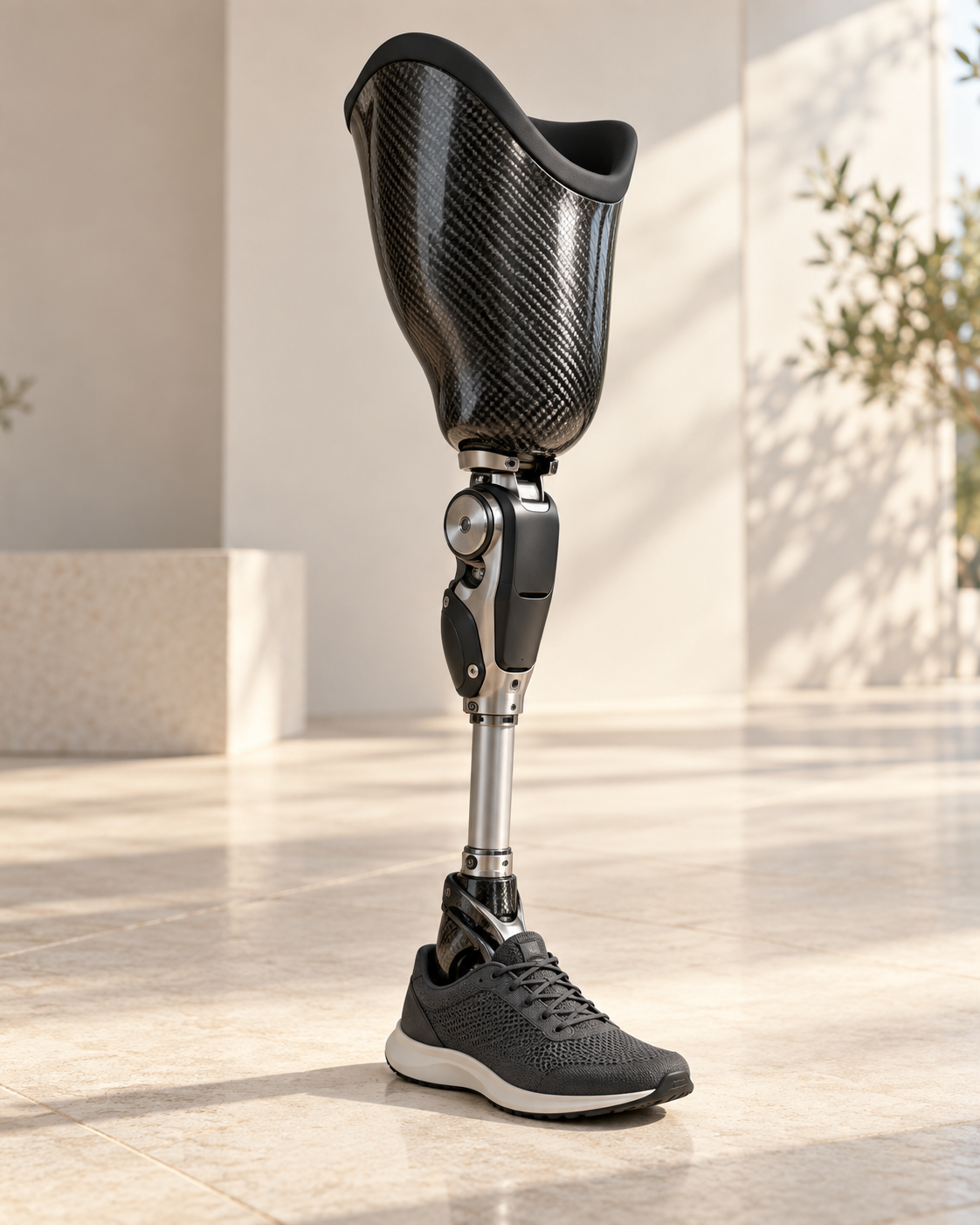 COMPONENT EXPLORER
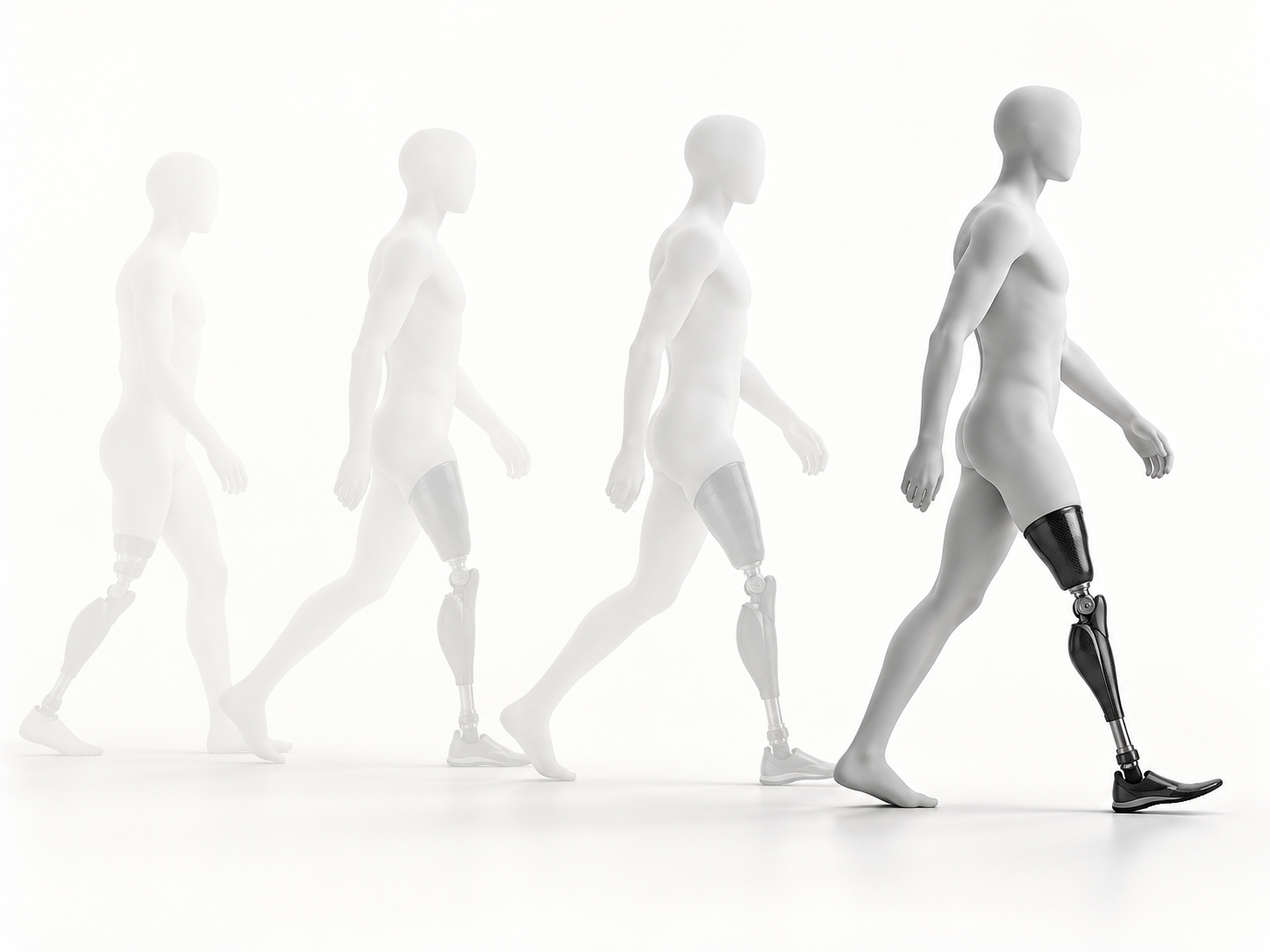
01 / MOTION
See a step unfold
Explore how the components work together in movement.
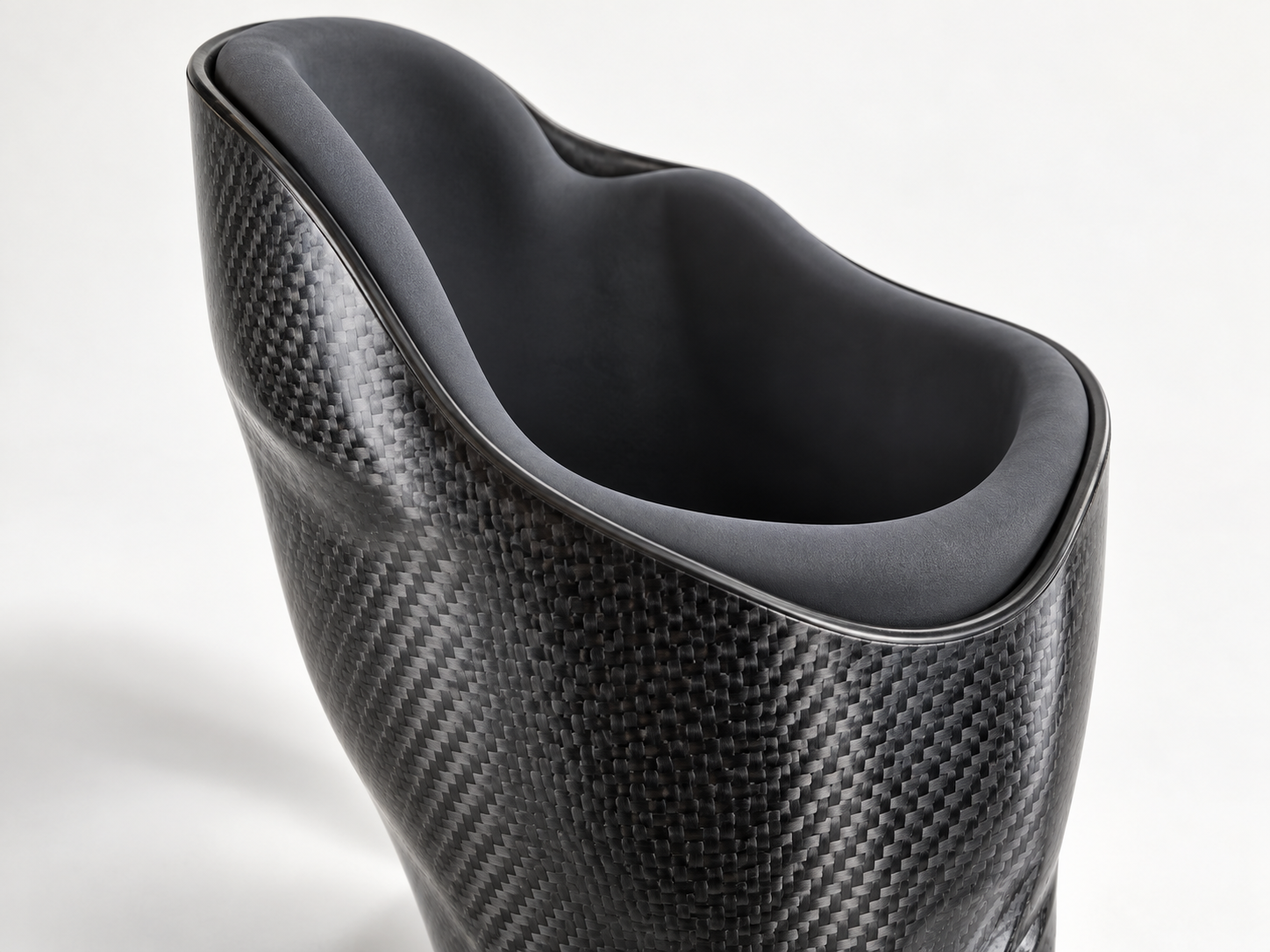
02 / FIT & CARE
Understand
everyday comfort
Explore sockets, liners and how fit changes through a day.
03 / YOUR VISIT
Better questions.
Better conversations.
Bring your goals, comparisons and questions together.
TheProstheticAtlas
An independent field reference for choosing, wearing, maintaining and troubleshooting an artificial limb, and for following the research that is changing what one can do. Written for people with limb loss, their families, and the clinicians who work alongside them.
Or start by choosing the level of your limb difference on the drawing. Everything below adapts from there.
Where is the limb difference?
THE MOTION STUDIO / 01
Every step, understood.
Slow down a stride. Compare two knee concepts. See the relationship between movement, materials and time.
Explore the lab or watch a film.
IN MOTION / 10-SECOND FILM
Beyond the walking stride.
A runner moves through a sunlit park with a prosthetic leg. Pause or slow the clip to take a closer look.
Illustrative running video. Choose Interactive lab to explore the separate walking simulation.
Return to the interactive lab →GAIT ANALYSIS / 10-SECOND FILM
A stride, seen from every angle.
Follow a treadmill walk through an illustrative motion-capture lab, with cameras, body markers and changing views of the prosthetic leg.
Illustrative gait-analysis scene. On-screen readouts are part of the film, not patient measurements.
Return to the interactive lab →READ THE MOVEMENT
One clock. Every angle.
The fourth dimension is time. Motion is synthesized for education, not captured from a person. Component shapes are generic. Independent clinical review is pending.
Limb loss, in numbers
Who needs a prosthesis, why, and how many people can get one. The picture is growing and unequal: most limb loss in the US now follows vascular disease, and worldwide most people who need a prosthesis never receive one.
Limb loss and limb difference in the US
Each figure stands for 100,000 people. A 2024 claims analysis counted 5.6 million people in total; a separate 2024 study projects 5.6 million living with limb loss alone by 2060.
Why limbs are lost
Share of people living with limb loss in the US, by cause, in the last full national estimate (2005). The 2024 analysis found that 57% of people who had an amputation had diabetes beforehand.
Access worldwide
Only 1 in 10 people who need assistive products, prostheses included, has access to them. Across 35 countries, access ranged from 3% of need in poorer nations to 90% in wealthy ones.
An estimated 35 to 40 million people need prosthetic or orthotic services.
Prosthetists and orthotists per million people
WHO recommends at least 5 to 10 per million; many lower-income countries have about one.
Inside a prosthetic leg
A working model built part by part. Drag to turn it, pull the parts apart to see how they stack from socket to foot, and select any part to learn what it does and what the alternatives are.
Explore the lab or watch a film.
INSIDE THE PROSTHESIS / 10-SECOND FILM
One leg. A system of parts.
See the socket, knee, pylon and foot separate in an exploded assembly, with visual callouts connecting the components.
Illustrative assembly and callouts, not an exact manufacturer specification.
Return to the interactive lab →Level
Parts
Build a starting configuration
Answer four questions and the atlas assembles the component families a prosthetist would most often consider for someone like you, with the reasoning and the questions worth bringing to your next appointment. It is a conversation starter, not a prescription.
Component library
Every prosthesis is a system of parts: interface, suspension, joints and a foot or terminal device. Open a family to see what it does well, where it falls short, and representative products. Tick up to three to compare.
Activity bars show the Medicare Functional Classification Levels (K1 to K4) each family is usually matched to. Upper-limb families are not classified this way. Product names are representative examples; availability, naming and coverage differ by country and insurer.
Every model, every make
A catalogue of prosthetic components by manufacturer, compiled from 2025 and 2026 catalogues and announcements. Filter by make, category or activity level, open any model to turn it in 3D or see real photos of it, and compare up to four. Each model shows whether its details have been checked against a source; Ottobock and Össur entries were checked against the makers' own product pages in September 2026, including recent launches and discontinuations. Names, availability and coverage differ by country, so confirm specifications with the manufacturer and your prosthetist.
3D views show the component family each model belongs to, not the manufacturer's exact design. Product names are trademarks of their owners. Status reflects what the manufacturers published at the time of review, September 2026.
Paying for it, and who fits it
Cost, more than specification, decides what many people end up wearing. In the United States only about 30% of Medicare beneficiaries who lost a limb in 2016 received a prosthesis within three years. This section covers typical prices, how coverage works, how to appeal a denial, and how to choose the clinician who builds your limb. Figures are US-centred; the principles travel.
Where the money comes from
When coverage is denied
Evidence that gets devices approved
Choosing your prosthetist
Wearing it, day to day
Most problems with a prosthesis start with small habits: how it goes on, how long it is worn in the early weeks, and how the limb is managed through the day. These are the routines prosthetists and physical therapists teach first.
Read the guide or watch the film.
EVERYDAY MOVEMENT / 10-SECOND FILM
From sitting to moving.
A close-up follows a prosthetic leg as its wearer rises from a chair and walks through a rehabilitation space.
Illustrative movement sequence. It does not demonstrate an individualized transfer or walking technique.
Return to the daily-use guide →From first fitting to full-time use
- Before fitting
Shrinker or compression wrap to shape the limb and control swelling. Desensitisation, scar mobility, core and hip strength, and learning to transfer safely.
- First check socket
A clear test socket lets your prosthetist see pressure. Report every hot spot; this is the cheapest moment to change the shape.
- First weeks of wear
Build wear time gradually, often starting around an hour or two a day in short blocks, taking the prosthesis off to inspect skin after each. Follow your clinic's schedule rather than a generic one.
- Gait or skills training
Weight shifting, balance, then walking between parallel bars, then with an aid, then outdoors, slopes and stairs. Upper-limb users practise opening and closing in different arm positions before real tasks.
- Months 3 to 12
The limb keeps shrinking. Expect sock changes, socket adjustments and often a replacement socket once the volume stabilises.
- Long term
Review with your prosthetist at least yearly, sooner after weight change, a new job or sport, or any new pain.
Situations people ask about
Life after limb loss
The device is half of it. The rest is pain, mood, work, getting around, and the people who have done it before you. None of this replaces your care team; it is here so you know what to ask about and that none of it is unusual.
Hand lab
A multi-articulating myoelectric hand driven by simulated muscle signals. Start with two-site control, the way most people learn, then switch to pattern recognition and watch a classifier read intent from eight electrodes. Lower the signal quality to see why socket fit and clean skin matter.
Control method
Contract a muscle
Press and hold. Switching grip sends both signals at once, the co-contraction real users learn.
Think of a movement
Signals are simulated to show how control works. Real muscle signals are noisier and differ from person to person, which is why every hand is calibrated to its user.
Maintenance routine
A prosthesis is a mechanical device worn against living skin; both need regular attention. Tick items as you go. Your progress is saved in this browser only, so each person using the page keeps their own list.
CARE / A CLOSER LOOK
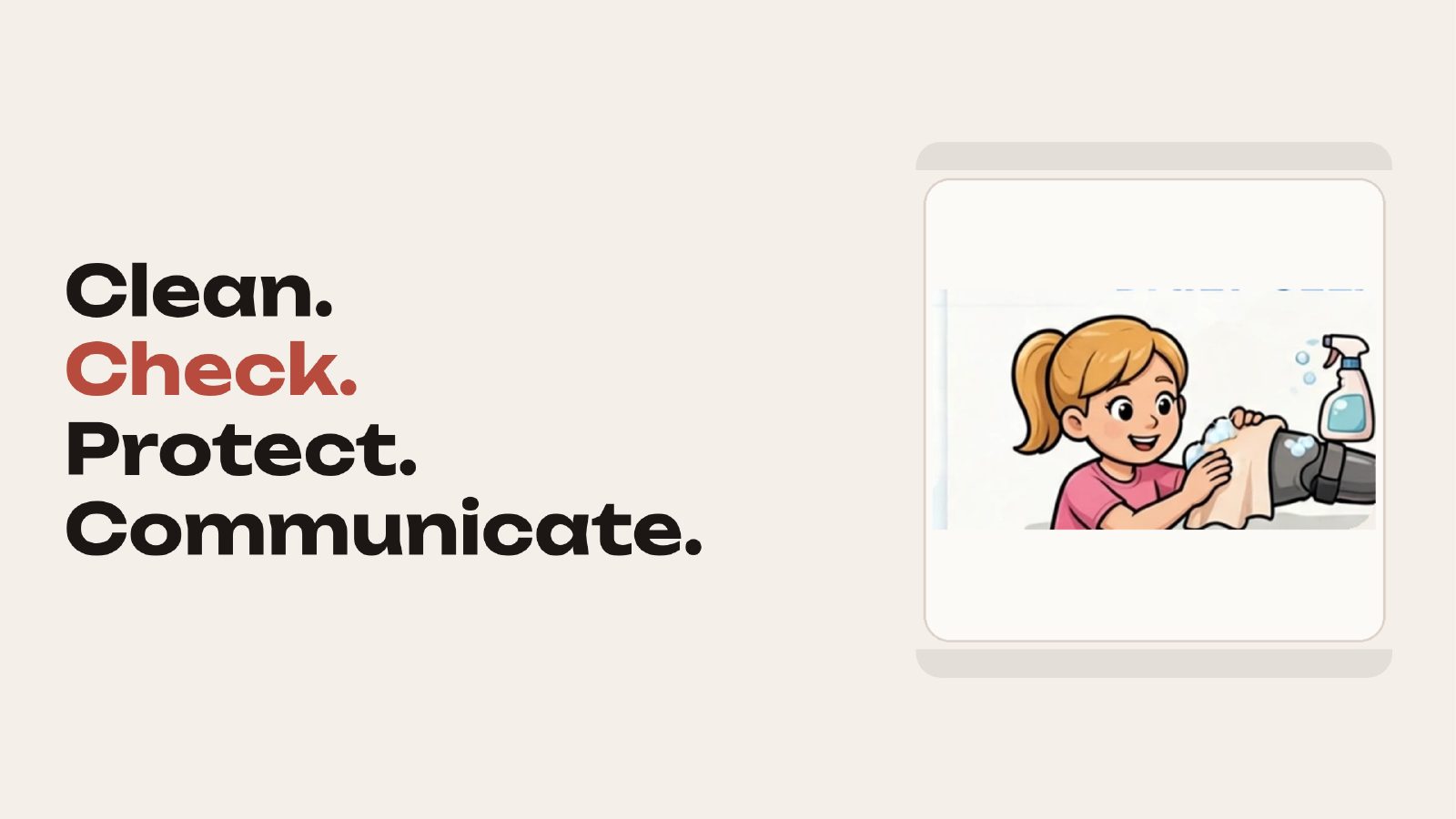
The care workbench.
A detailed illustration of prosthetic components, a care station and a maintenance checklist. Open the image to explore the scene, then return to your own checklist.
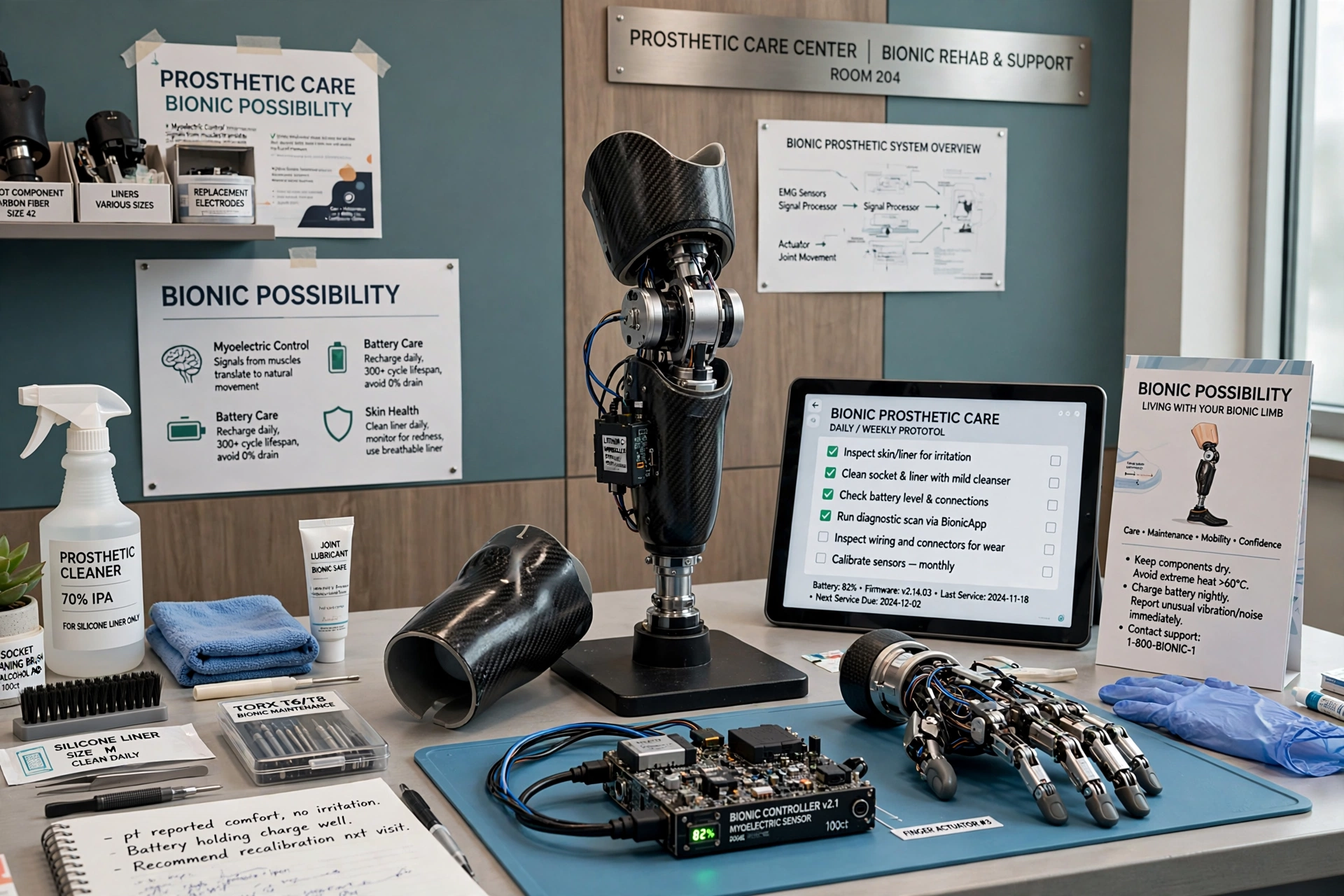
Illustrative artwork. Cleaning products, battery figures and servicing steps pictured here are not instructions for your device. Follow its manufacturer’s manual and your care team’s guidance.
Go to my checklist →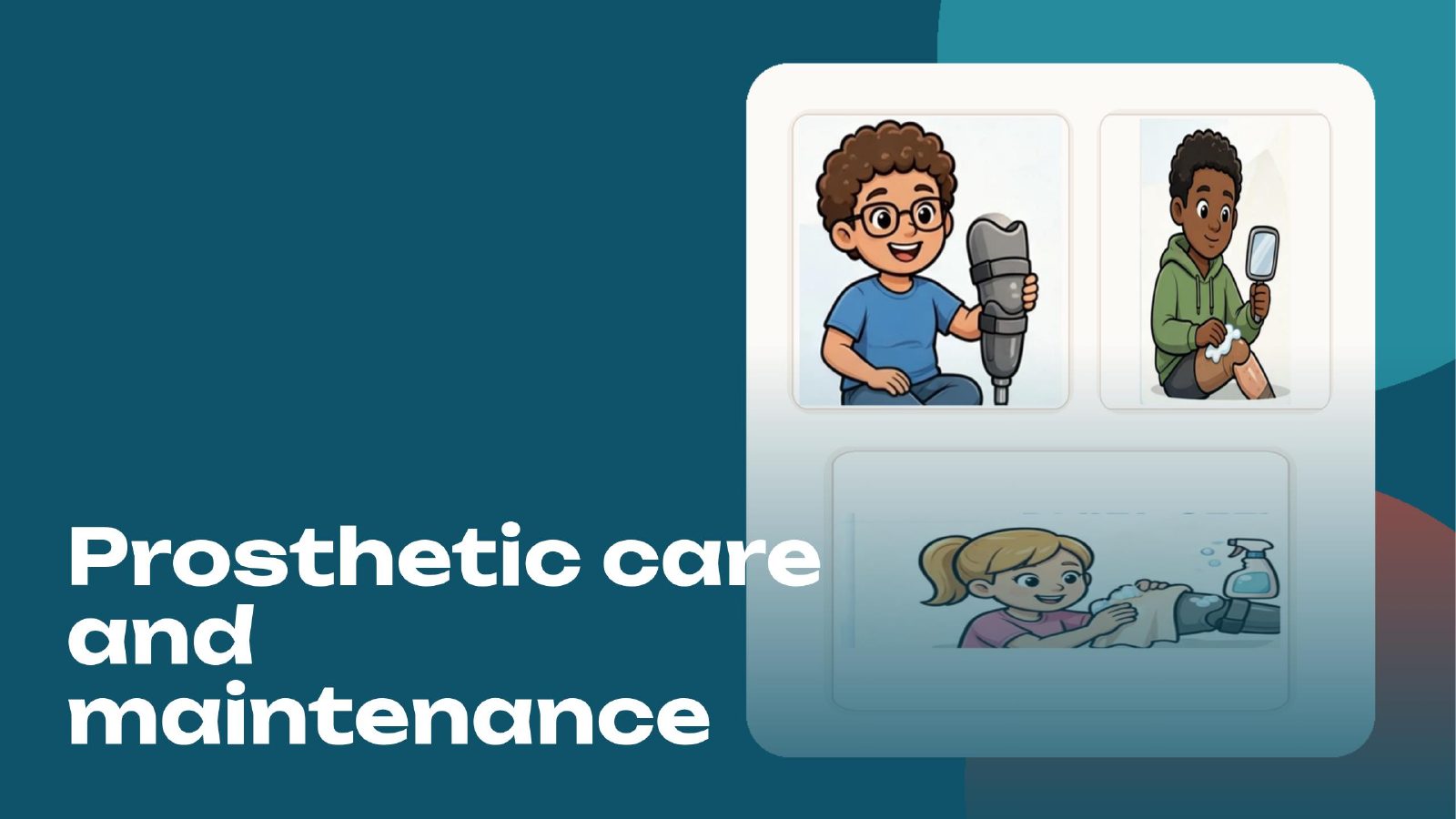
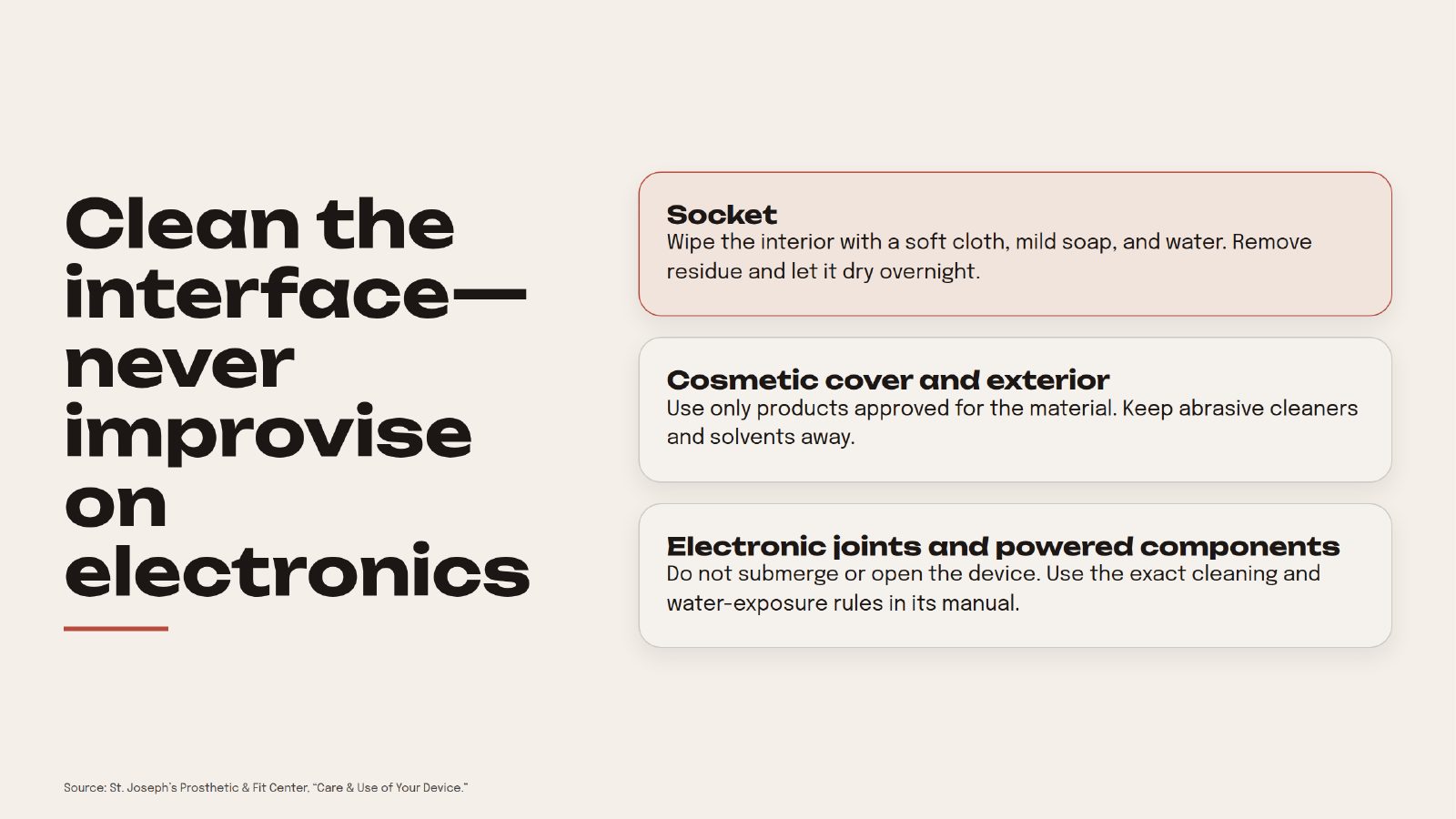
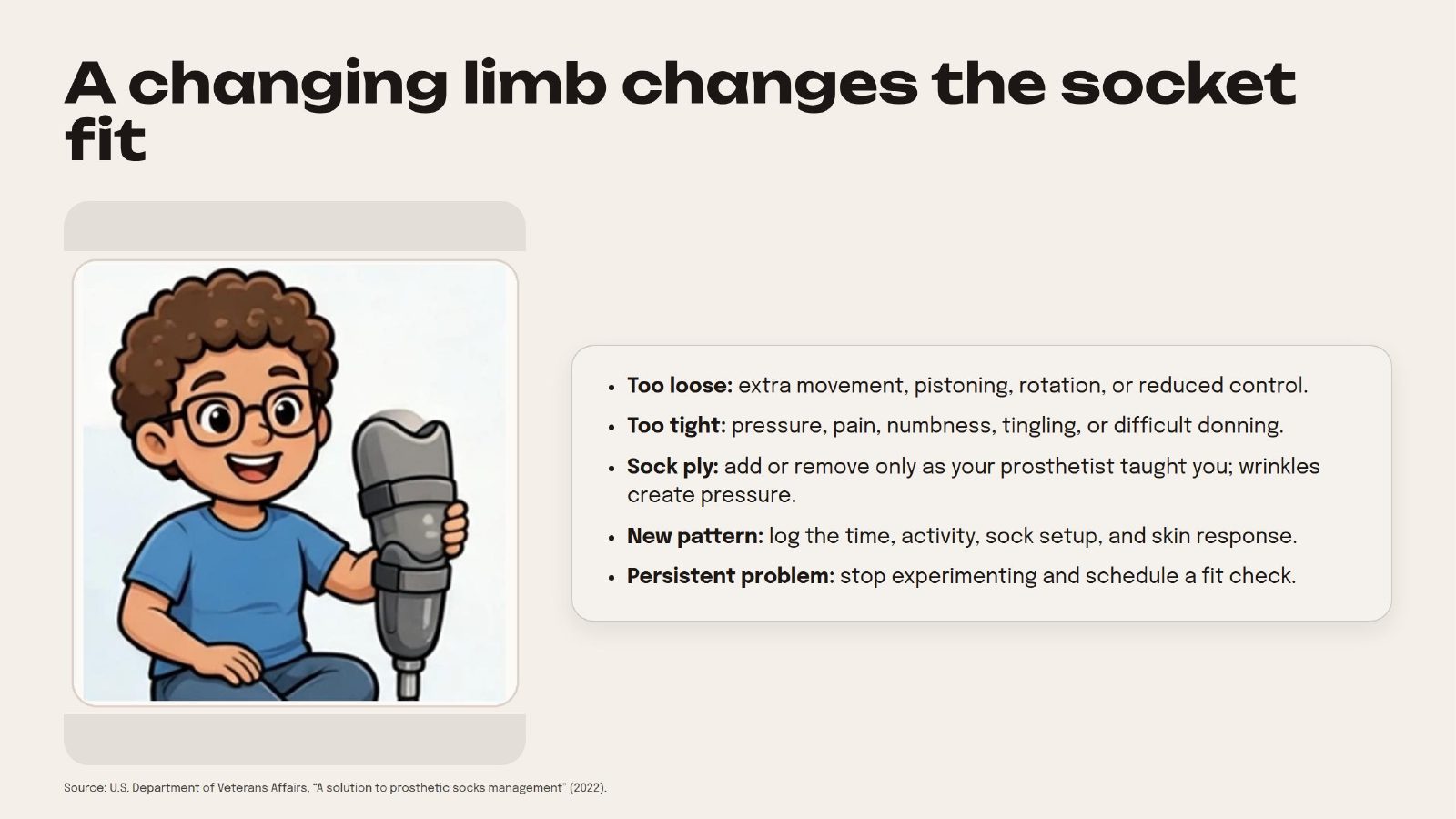
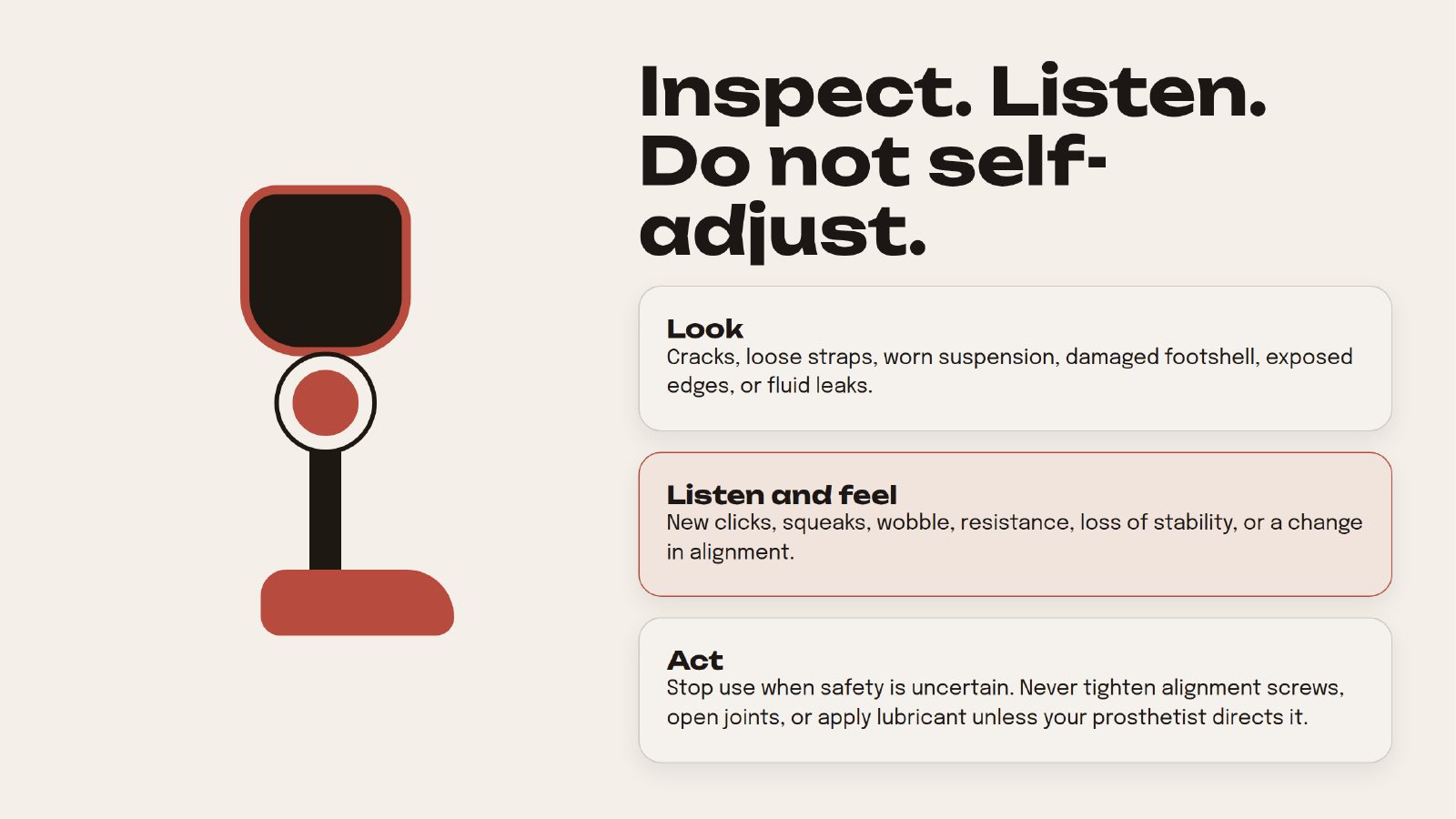
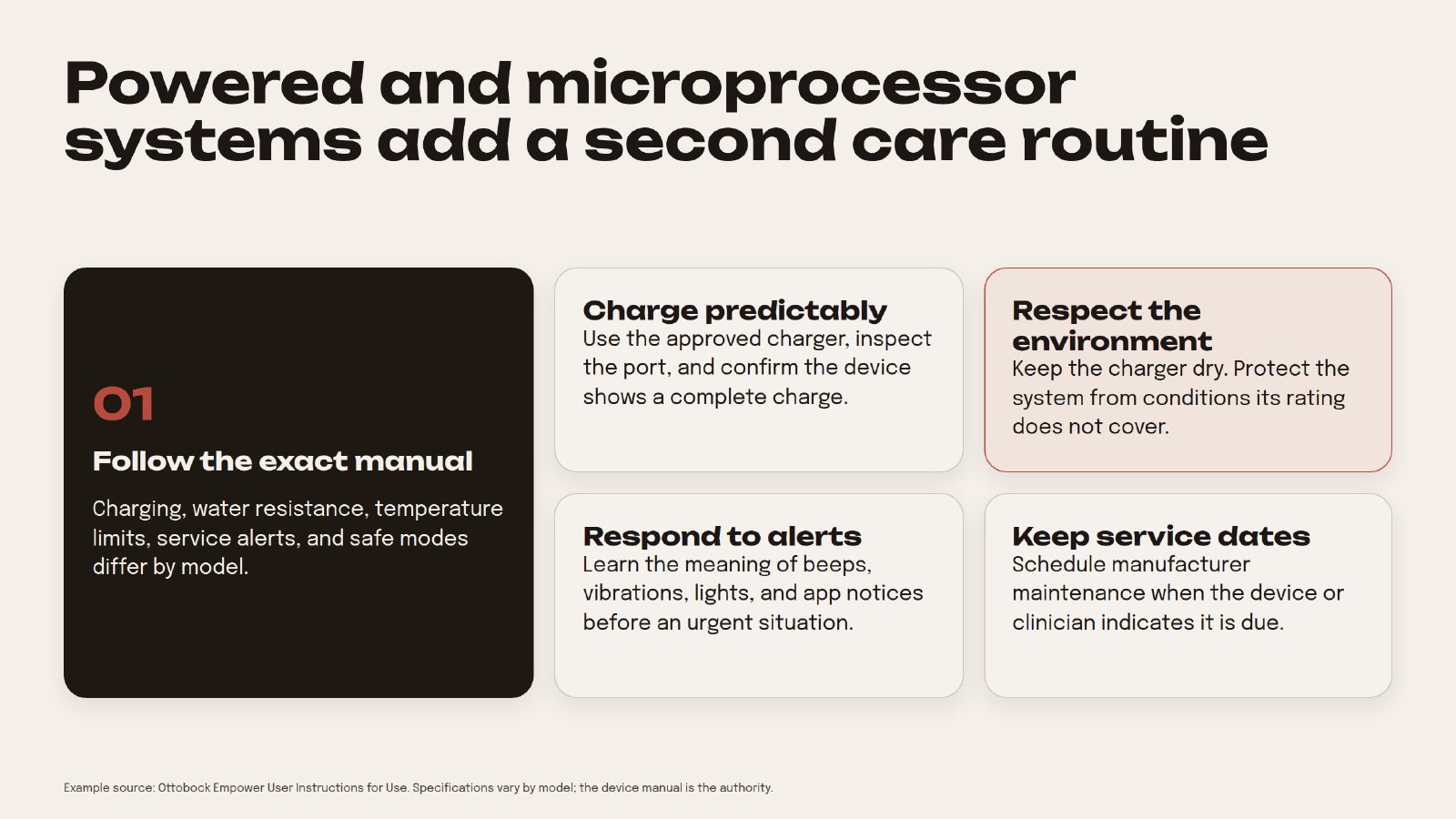
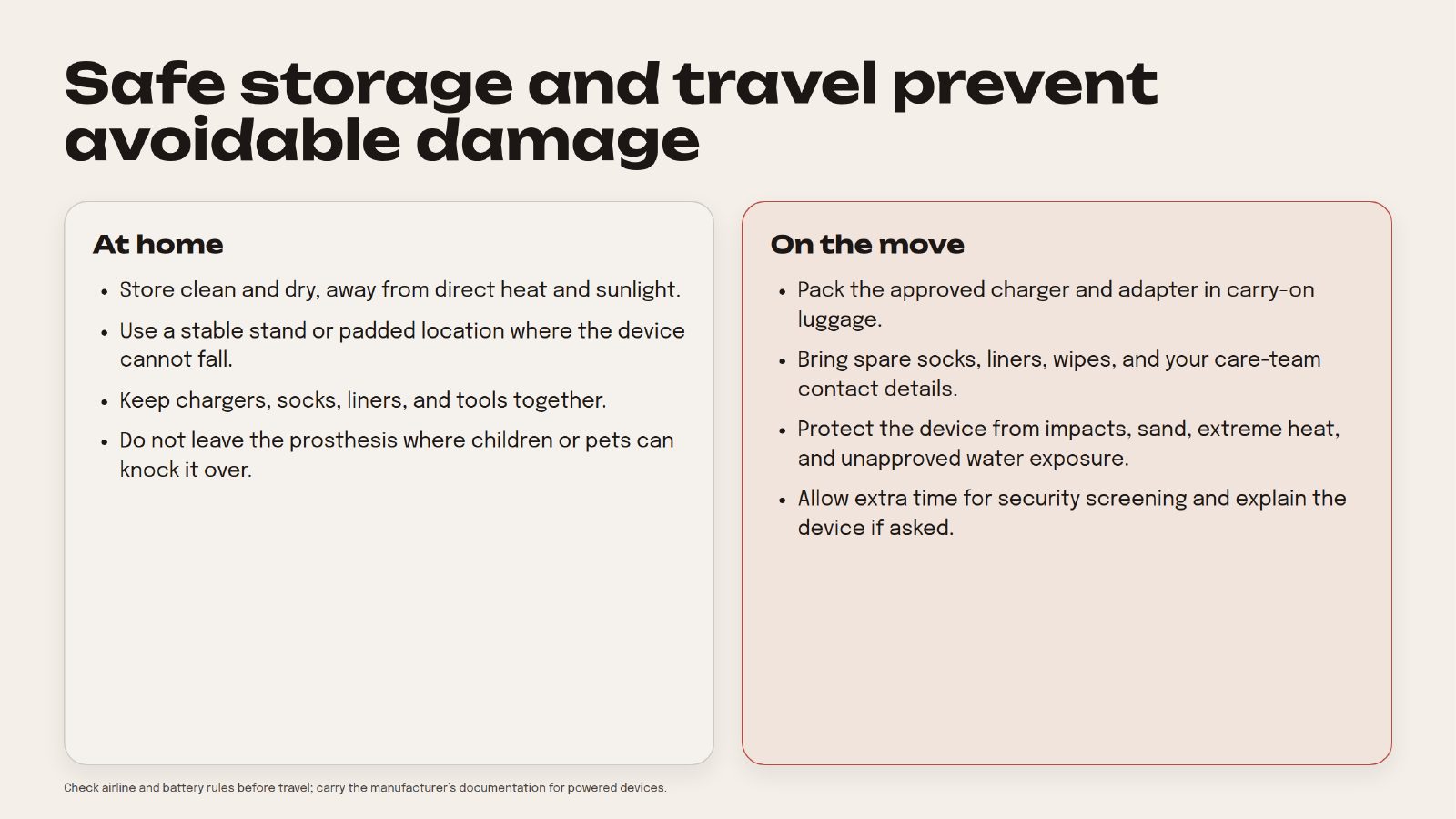
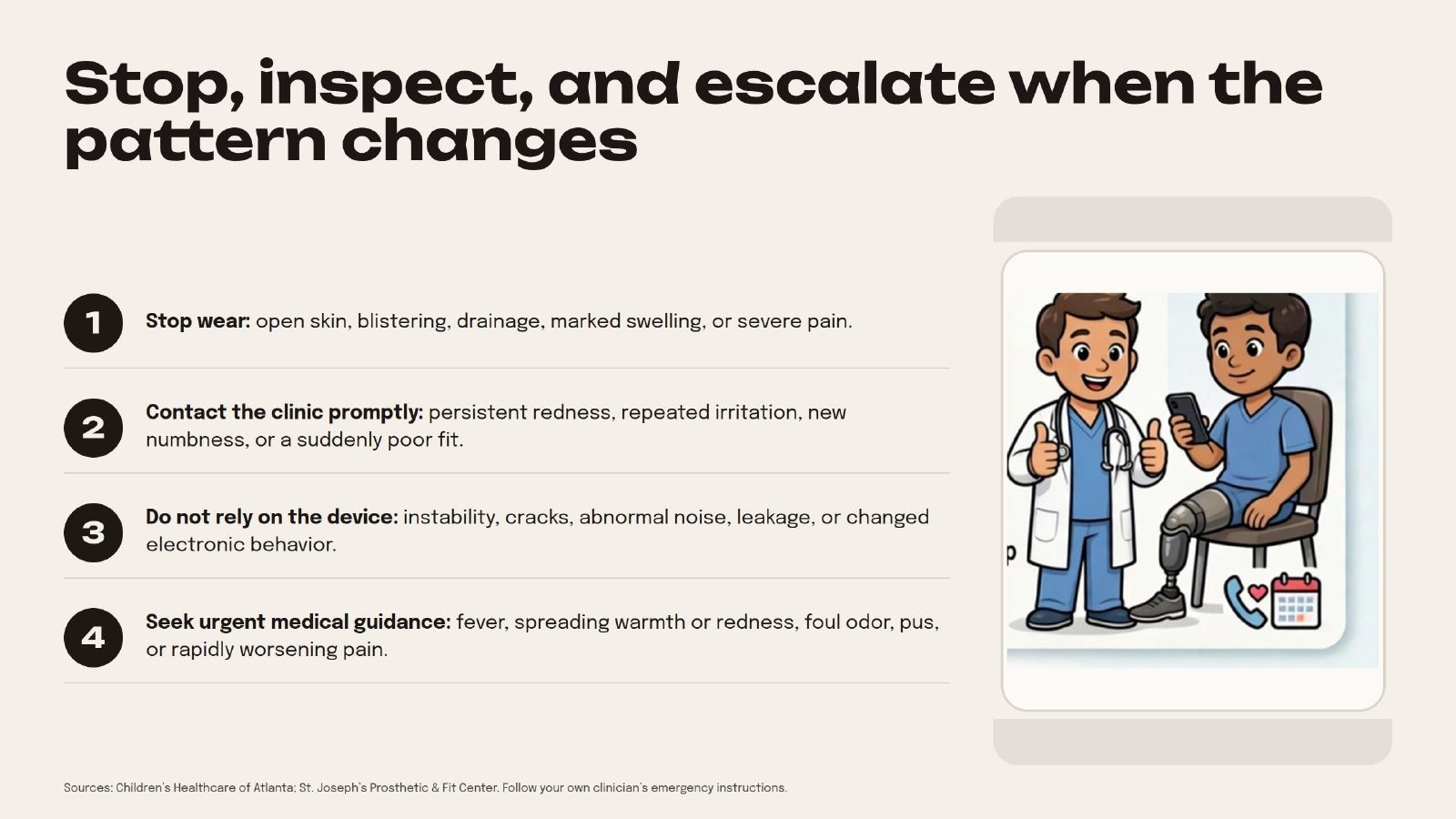
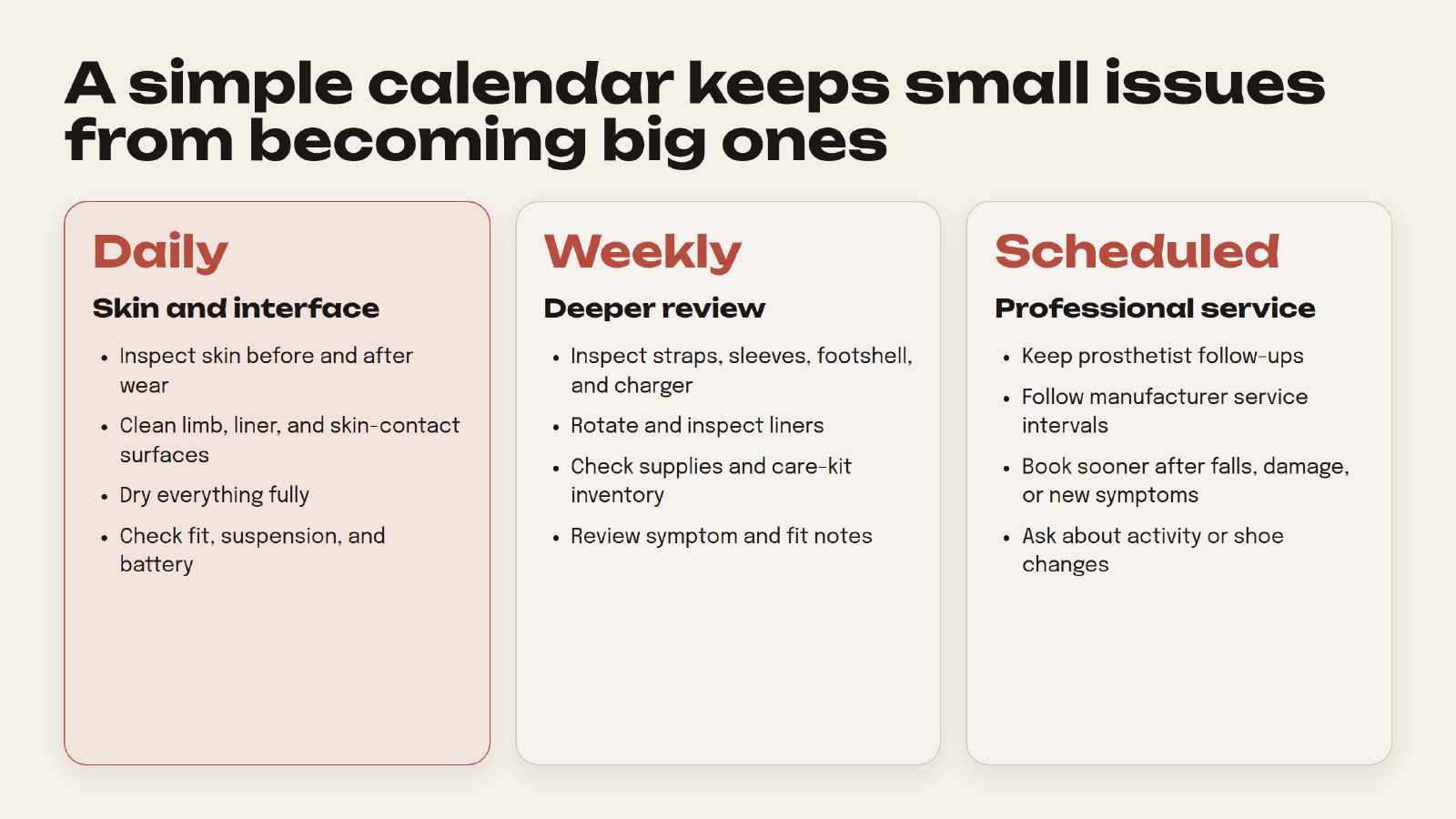
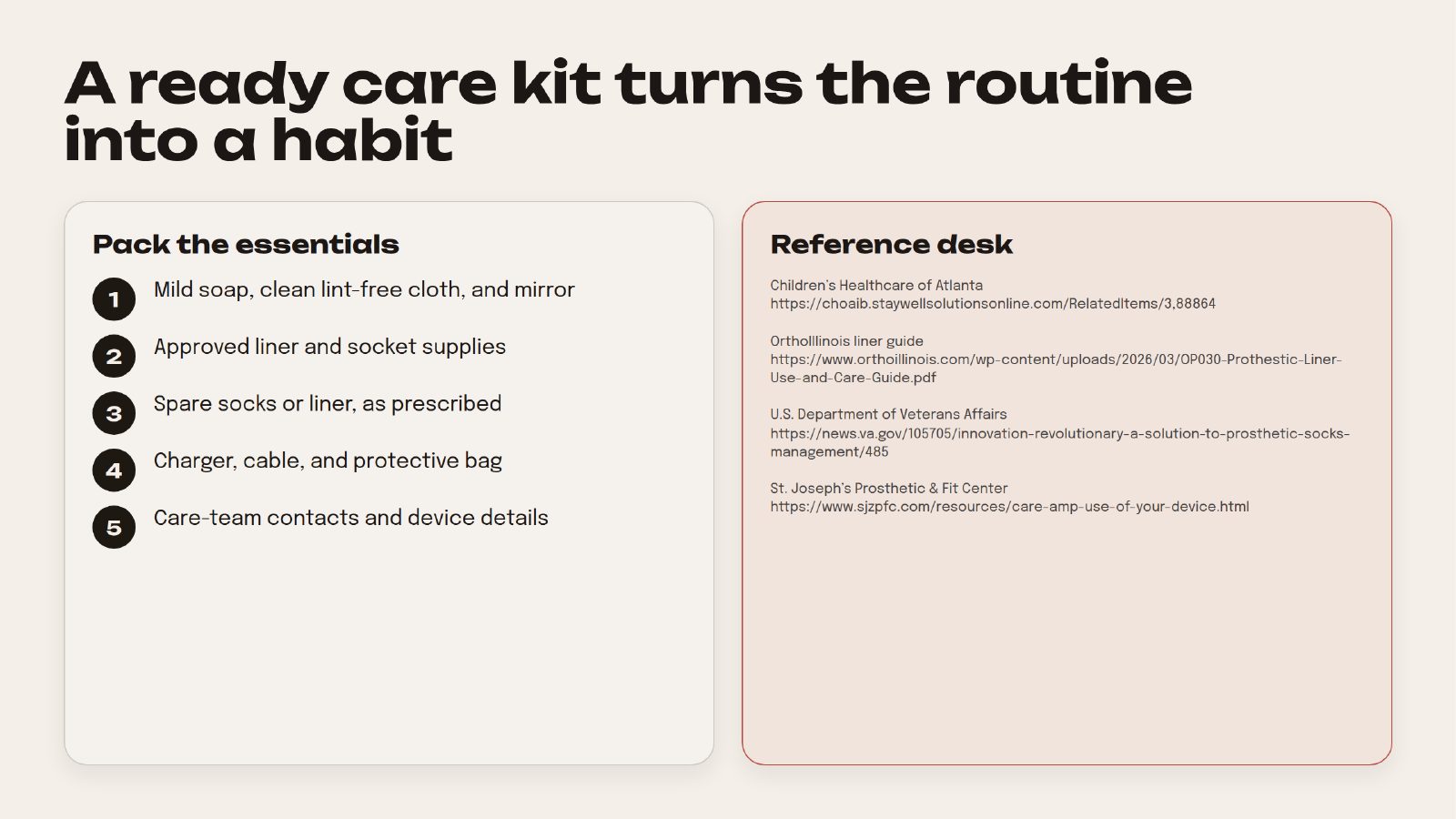
CARE / GUIDE
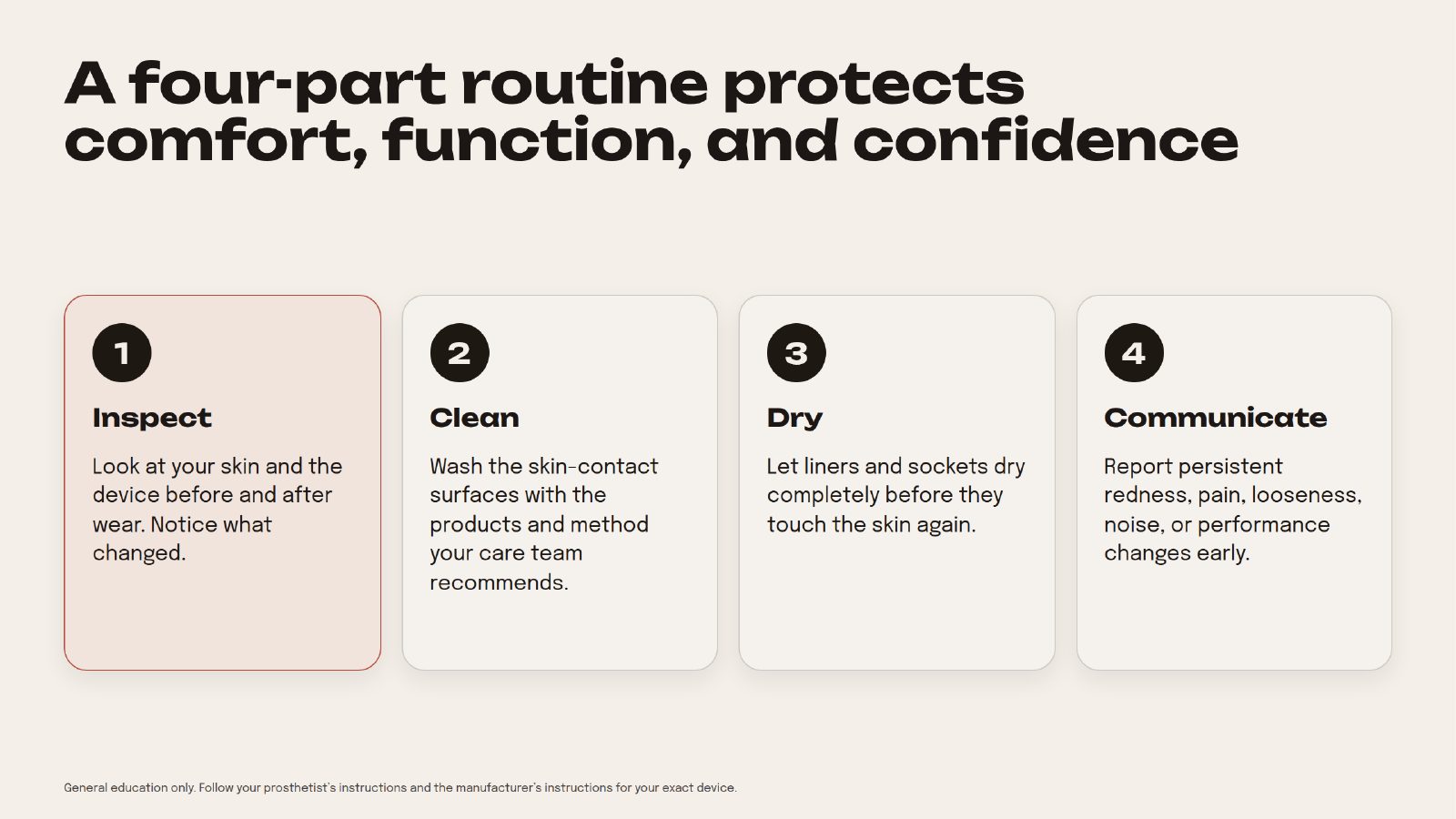
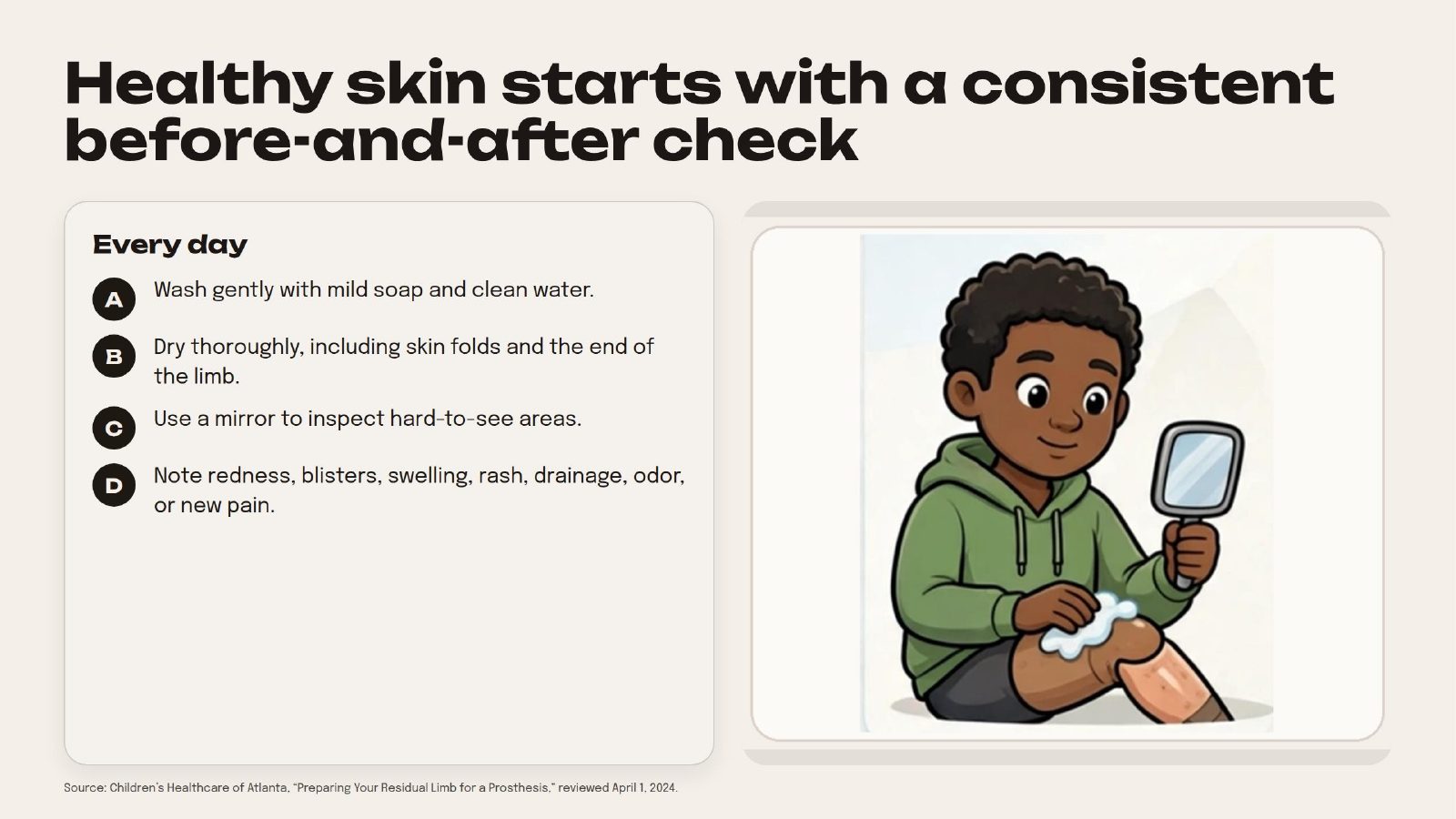
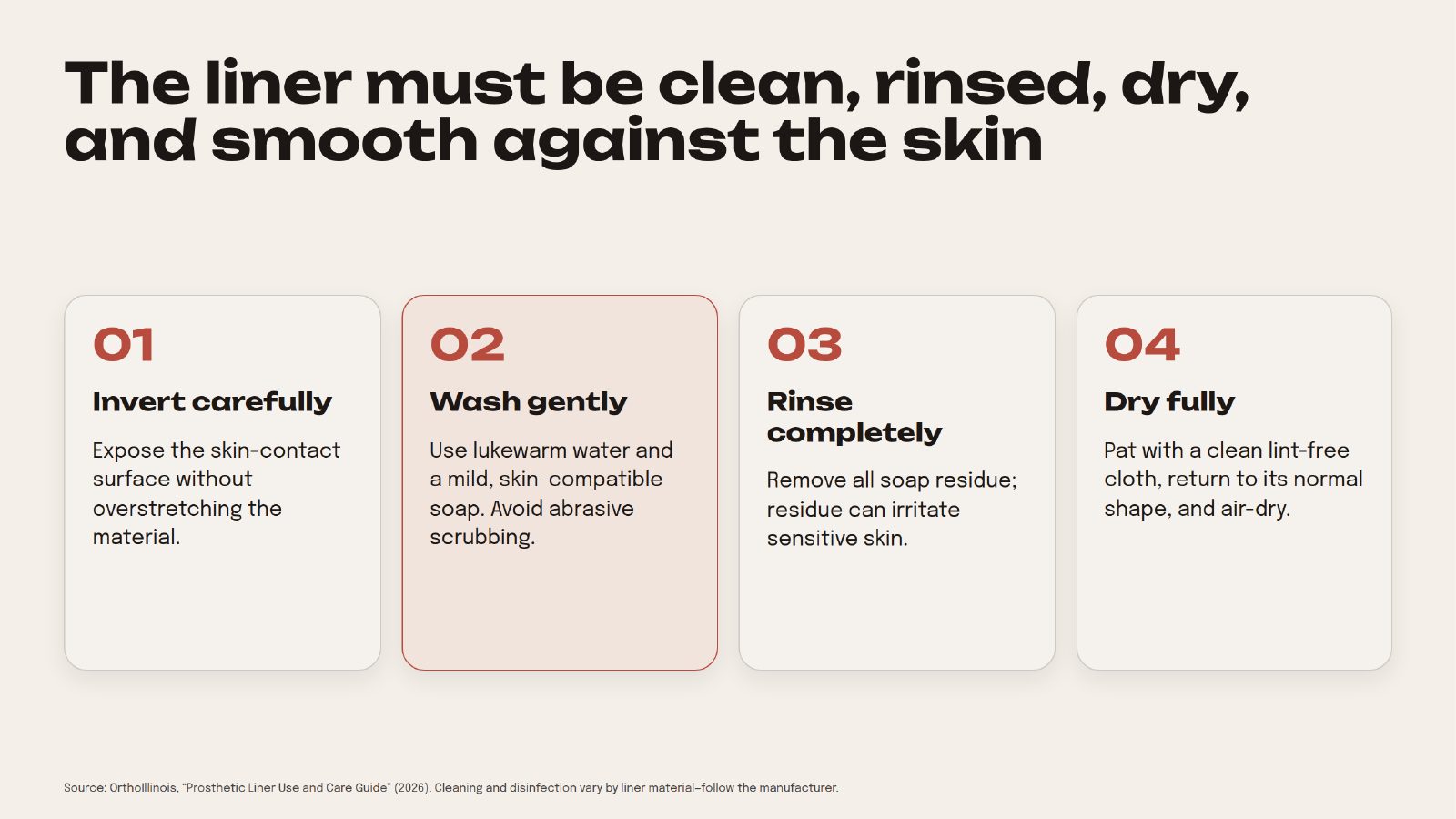
Care and maintenance.
Page 1 of 13. Move sideways to turn the page.
Educational reference. Where this guide and your device manual differ, follow the manual and your care team.
Go to my checklist →Sock ply gauge
Socks fill the gap as your limb volume changes through the day and over months. Slide to the total ply you typically need to feel secure.
THE INTERFACE STUDIO / 02
See what fit feels like.
Look through the socket. Move through a day. Compare an illustrative starting state with the changes that follow.
Explore the lab or watch a film.
SOCKET & FIT / 10-SECOND FILM
The fitting conversation.
Watch a clinician and a prosthesis user review the socket and leg together in an illustrative fitting appointment.
Illustrative fitting scene, not step-by-step fitting instructions.
Return to the interactive lab →CRAFT & FIT / 10-SECOND FILM
From the workbench to the next step.
An illustrative workshop sequence moves from hands-on work on a prosthetic leg to a wearer standing and walking nearby.
Illustrative workshop and walking sequence. It is not a repair procedure or evidence of a device outcome.
Return to the interactive lab →THE DAY IN ONE VIEW
A change you can follow.
This explorer does not assess your socket or tell you how many socks to wear. Its purpose is to make a changing interface easier to discuss with your care team.
Track your progress
Simple timed tests clinicians use, which you can repeat at home to see a trend. Do them with someone beside you, with your usual walking aid, and stop if you feel pain, dizziness or unsteady. Results stay on this device and flow into your appointment brief.
Troubleshooter
Pick what you are noticing. Each entry lists the usual causes, what is reasonable to check yourself, and the point at which to stop adjusting and call your prosthetist or doctor. The dot shows how quickly to act.
| What you or your therapist see | Level | Common prosthetic causes | Common user causes |
|---|
Safety and warning signs
Sorted by how fast to act. If you have diabetes or vascular disease, the skin of your residual limb and your remaining foot deserve the same daily attention.
Get urgent care now
- Red streaks spreading from a wound, with fever or chills
- A wound that opens, drains pus, or smells, especially soon after surgery
- Sudden calf or thigh swelling with pain, or sudden breathlessness or chest pain
- A fall with a head strike, confusion, or a limb you cannot bear weight on
- With a bone-anchored implant: new severe pain, bleeding or discharge at the stoma, or fever
Call within a day or two
- Redness that has not faded 20 to 30 minutes after taking the prosthesis off
- A blister, abrasion or any break in the skin
- New or worsening pain when wearing
- Two or more near-falls, or a knee that gives way
- A microprocessor component alarm that does not clear
- Swelling or dark discolouration at the end of the limb
Raise at your next visit
- Steady creep in the socks you need
- Weight change of a few kilos in either direction
- Visible wear on liners, foot shells, straps or cables
- Back, hip or sound-side knee ache after walking
- A new job, sport or goal the current setup doesn't suit
Recalls and device alerts
Manufacturers issue recalls and field safety notices when a component can fail. Your prosthetist should tell you, but check yourself when you receive a new part and once a year after. Search by manufacturer and product name.
A report in the FDA adverse event database is not proof that a device caused harm; reports are unverified. A recall is. If a component you wear is recalled, contact your prosthetist before you stop using it, unless the notice says to stop immediately.
The frontier
Where the field is heading, placed honestly on a maturity scale from laboratory work to routine care. Open any line for how it works, who it is for and what is still unresolved. Reviewed September 2026.
Five centuries of the artificial limb
The essentials, in plain language
Nine things every prosthesis user should know, in English, Spanish and French. Short enough to print for a family member or carer. The translations were prepared for this atlas and have not yet been checked by native-speaking clinicians.
START HERE / VISUAL OVERVIEW
Prosthetics 101, in one view.
An English-language illustrated overview of limb levels, components, materials, technology and care. Enlarge it to read the details, then explore the Atlas topics below.
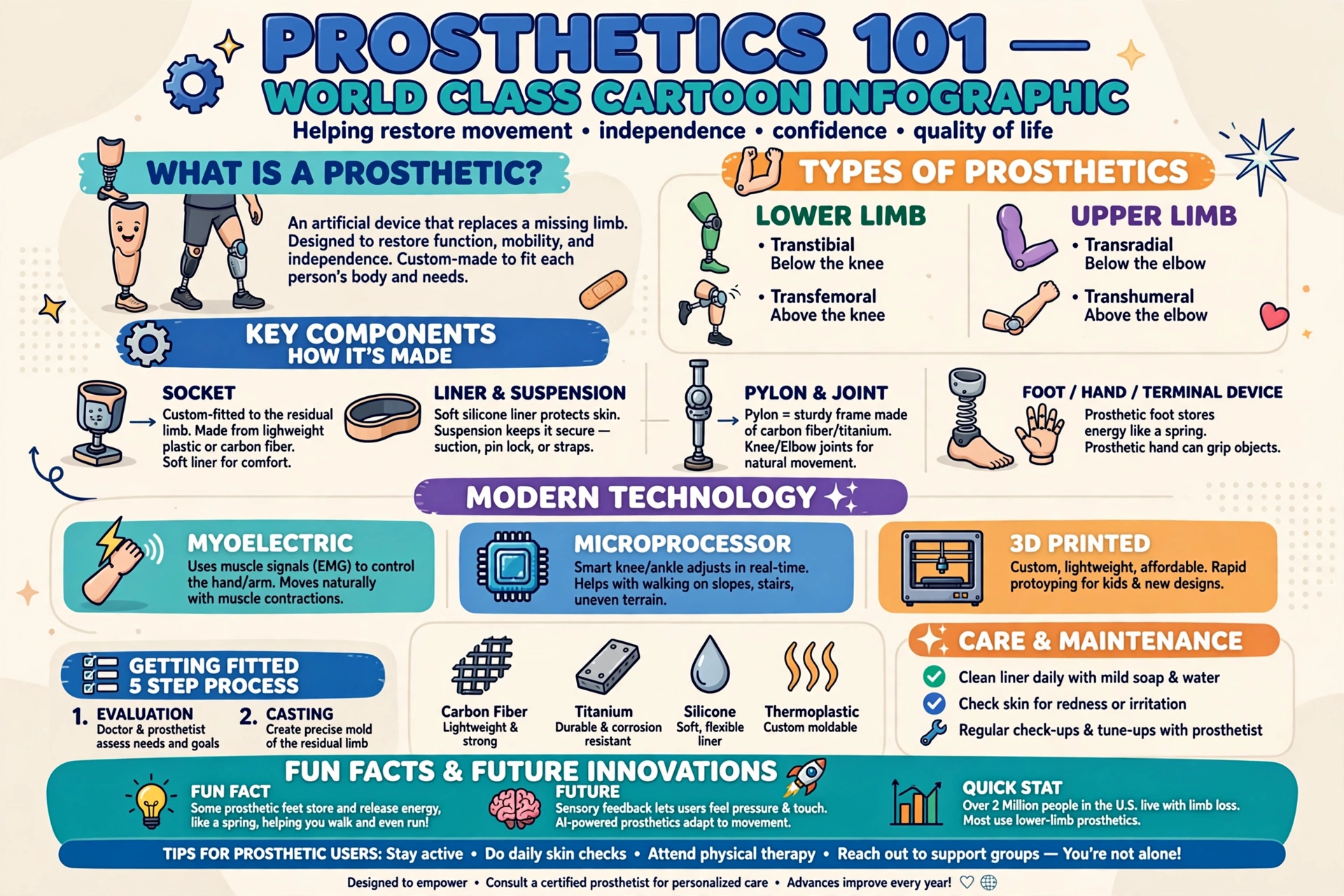
Illustrative overview. Statistics, technology claims and care advice printed in the artwork have not been independently verified. The fitting sequence shown is incomplete; this is not a clinical guide.
Explore limb levels →Glossary
The words you'll hear in the clinic, in plain terms.
Sources and further reading
Every numbered marker on the page opens its source. Peer-reviewed studies are listed with journal and year so they can be looked up in any library database.
Review log
What has been checked, and what has not. This page will stay marked pending until named, credentialed reviewers have signed off each section.
| Section | Literature check | Clinician review |
|---|